
CLEARVIEW · Focused exploration methodology
Understanding Subduction to Find a Porphyry
Tectonic Preconditioning: Predicting Where Giant Porphyry Deposits Form
Why do some magmatic arcs host world-class porphyry copper-gold deposits while others, despite seemingly similar geological conditions, remain poorly mineralised? Our research, published in the Society of Economic Geologists (Richards & Holm, 2013), proposed a fundamental link between the formation of giant porphyry deposits and the subduction of major oceanic transform faults and fracture zones. These structures, characterised by extensive hydration and alteration of the oceanic lithosphere, can generate exceptional volumes of mineralising fluids and influence mantle melting, magma fertility and ultimately the location of major mineral deposits. Using plate-tectonic reconstructions, we demonstrated compelling spatial and temporal relationships between the subduction of major oceanic fracture zones and the formation of giant Andean porphyry deposits, including El Teniente, Río Blanco and Los Pelambres.
For mineral explorers, the implications are significant. Conventional exploration approaches often focus on identifying favourable geology, alteration and geochemical signatures without fully considering the deeper tectonic processes that determine where fertile mineral systems develop. By integrating plate-tectonic reconstructions, subduction dynamics and upper-plate structural architecture, Keystone Geo seeks to bridge this critical gap, providing a more predictive framework for identifying prospective mineral belts, prioritising targets and exploring beneath cover. Our approach moves beyond identifying where deposits could occur to understanding why particular locations may be exceptionally prospective.
Publication: Richards, S.W. & Holm, R.J. (2013). Tectonic Preconditioning and the Formation of Giant Porphyry Deposits. Society of Economic Geologists, Special Publication 17, pp. 265–275.
Read the original publication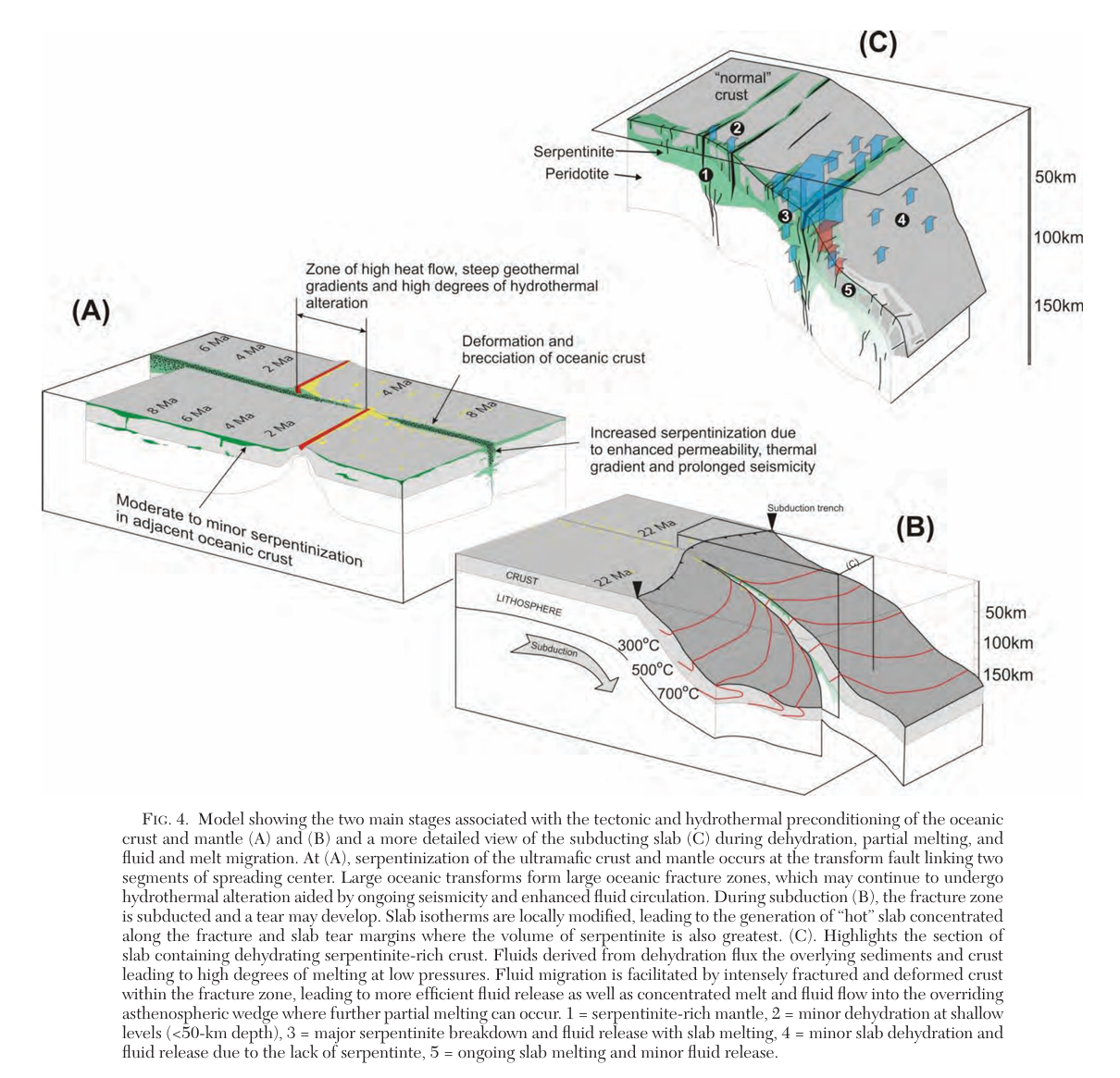
Porphyry copper-gold systems form above subduction zones, but not every subduction zone hosts one. The difference often comes down to what the subducting slab is doing beneath the arc — its shape, its angle, and how that geometry has changed through time.
Slabs do not descend as smooth, continuous sheets. Where a trench is pinched or indented by a bathymetric high, a plateau or a fracture zone inherited from the ocean floor, the slab can tear. Those tears change the way the slab sinks, which in turn changes the rate and direction of opening behind the arc, the location of arc volcanoes, and the chemistry of the magmas they erupt.
That matters for targeting. Volcanism and magmatism are the surface expression of what the slab is doing at depth, so a map of slab geometry and its evolution is a map of where the magmatic conditions for porphyry formation were actually met — and where they were not. Reading slab history is one of the most direct ways to narrow a porphyry search.
Open technical sheet